
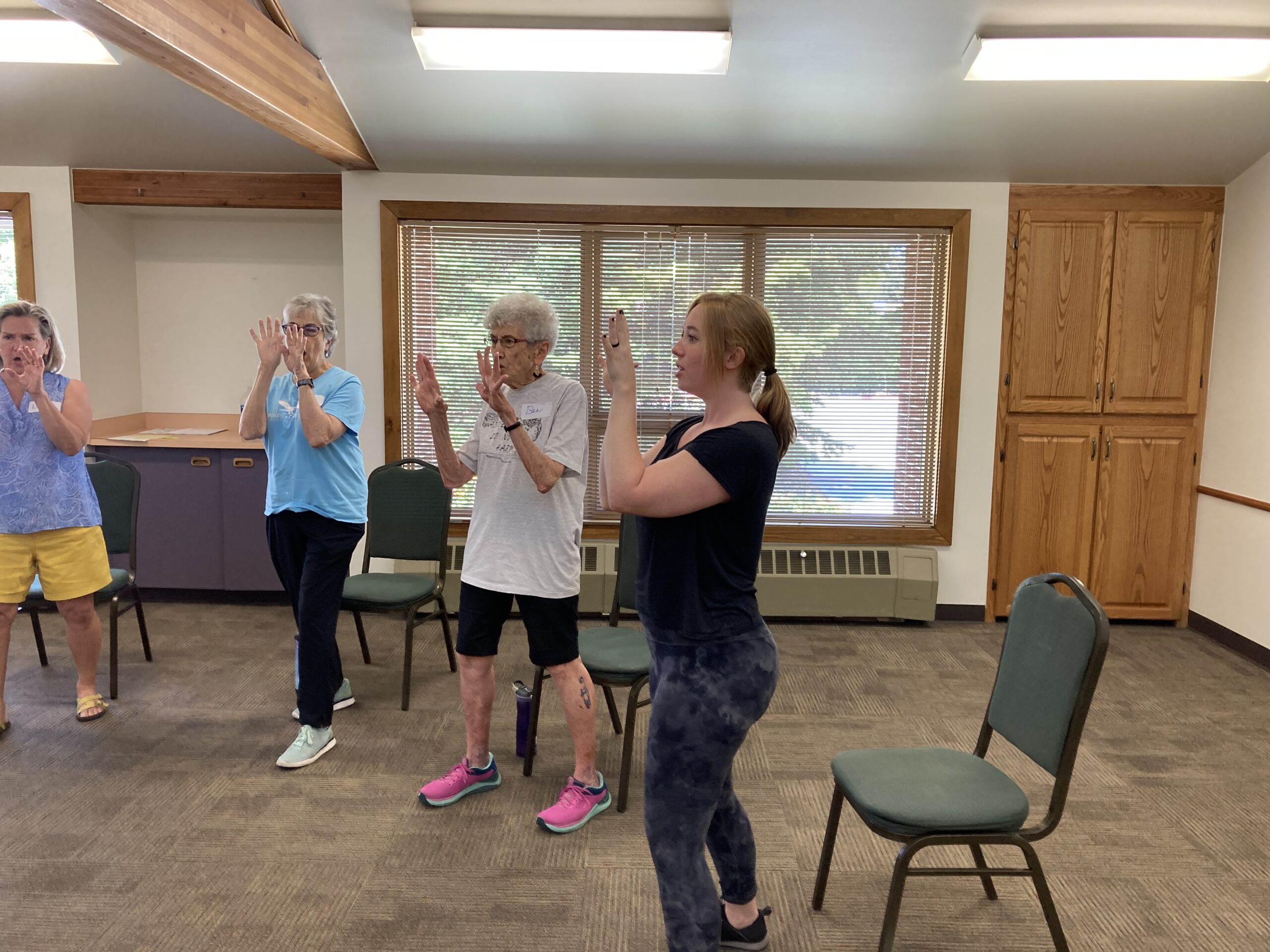
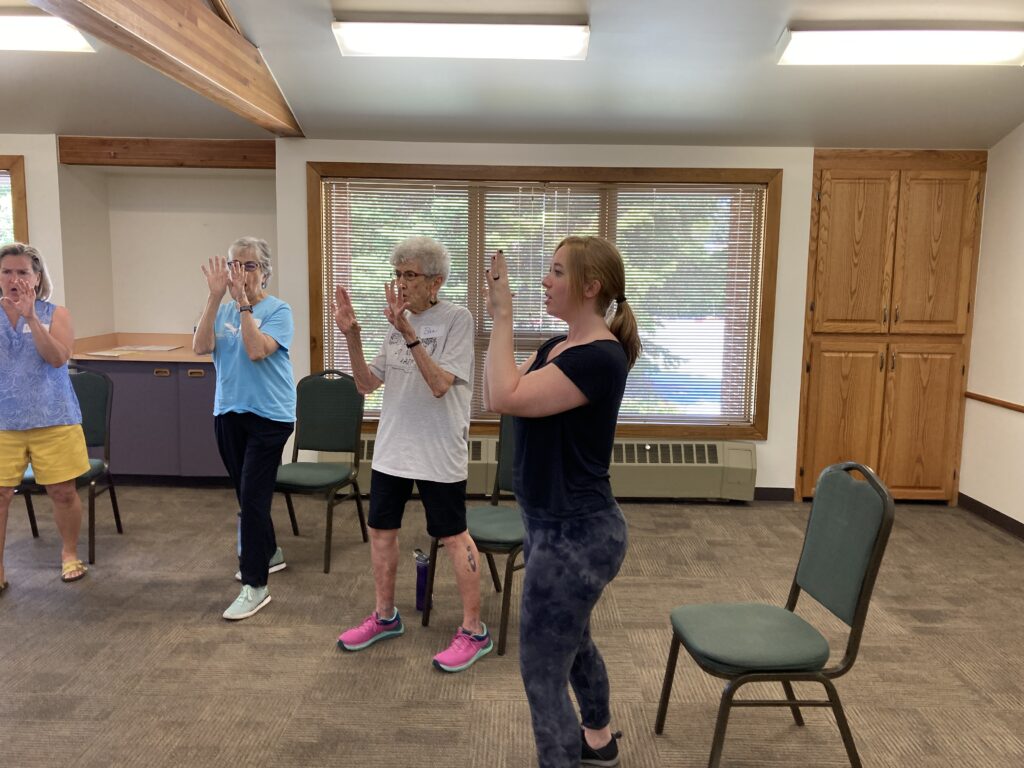
A few months ago, Kayla and I taught a self-defense class at a senior living community in Denver (listen to our radio interview about this class). The activity director brought us in because the seniors live in a busy downtown, many take public transportation, and many are navigating changes in their physical ability levels. A few of our students were users of walkers and canes, we even had a wheelchair user. Many were less certain with balance, and most of them had general mobility issues in shoulders, wrists, knees, and hips.
What does Self-Defense Look Like?
Do you think we looked at this group and said, “Okay, now we’re going to teach you to throw someone over your back to the ground, pin them, and punch in their face?” Do you think that would have been an achievable goal for us as instructors? Do you think that would have been an effective, ethical, and actually useful way to teach a group of seventy- to ninety-year-olds?
You may be asking, why am I even suggesting we would teach that way to this community? Well, isn’t that what self-defense is? Physical dominance and strength, perfectly executed martial arts moves, and the ability to throw someone to the ground and smash their face in with your fists, all while uttering nothing but a few swear words or grunts?
When Self-Defense Only Works for Some Bodies
Maybe because our culture is so inundated with choreographed and highly edited fight scenes in movies and shows, people believe that defending themselves involves *only* superior physical maneuvers. Videos that show self-defense moves online overwhelmingly show physically fit, non-disabled, gender-conforming instructors and participants. None of them ever show how to set a verbal boundary or de-escalate a situation before they knock someone to the ground. Furthermore, to read the comments we receive online when we post our videos of simple boundary setting and physical techniques that anyone could do, the trolls tell our viewers they would be “fools” to believe that anything but a gun and/or rigorous martial arts training would actually save their lives.
There’s something about knowing and/or teaching self-defense that brings out the “warrior savior” personality. These people think they know the “best” and “right” self-defense techniques (read our blog post about this), they believe this is the “only” form of self-defense that actually will help people defend themselves, and they go as far as to say that other ways will “get you hurt”.
I’m sad to say that I once probably had this same mindset. Kayla and I were originally trained to teach a paradigm of self-defense that was created for able-bodied, strong, quick-moving, and younger women’s bodies. I would hazard to say this dynamic is what most people expect to see when they think of women’s self-defense–it’s what I thought when I started taking classes and then learned to teach.
Of course there’s absolutely nothing wrong with able-bodied people learning how to fight. Learning to fight made me feel strong and capable; I became more confident; I found my voice; I became less shy and fearful. Learning self-defense changed my life. But as I learned to teach this same system that had provided me so much transformation, I began to see its problematic side.
When we worked with people with disabilities, such as wheelchair and cane users, those who are blind, deaf, or neurodivergent, older adults, those with bad backs or painful joints, with trans and non-binary students, and with many people of color, I realized we could be doing things to serve these students in a better way.
When Inclusive Isn’t Actually Accessible
Our classes involved a lot of sitting on the floor, standing for long periods of time, frequently getting up and down from the floor to standing. We had assistants yell at the students when they all didn’t have their toes in a line. We coached (coaxed) students to yell as loud as they could, and it wasn’t “loud enough” until they reached some arbitrary volume level. We demonstrated disturbing and maybe even re-traumatizing techniques without giving any warning. We didn’t give students very much agency over their experiences. We touched students without first asking permission to move their legs or arms into place for strikes. We taught teens the same way we taught adults, including sexual assault scenarios. Our language was very gendered in a (false) narrative that only men are perpetrators and only women are victims, that men’s bodies are stronger in the upper body, that women are socialized to be submissive, etc. We only focused on gender-based violence without acknowledging or addressing the myriad other types of violence people experience. We didn’t do enough work to functionally adapt techniques for students who couldn’t do certain strikes or movements. We were primarily focused on the performance of students, “rewarding” (in hidden ways) those who were more physically strong, clean-fighting, quick-thinking, and neurotypical. (To be very clear, we don’t teach like this at We Are Safer Together, and we have worked hard to eliminate all experiences like this from our courses.)
It was not uncommon for us to end a class with fewer students than when we started. This was commonly justified with reasoning like “some students aren’t ready for our work” or “we aren’t for everyone”. I wonder how many students would have stayed had we been able to more intentionally create a space for them?
I don’t want this extensive list to sound like we didn’t actually teach effective skills, I know we did. We changed lives. Also, my mentor was very thoughtful about making changes so we were more and more inclusive as time went by, but we were working within a strict framework like most traditional self-defense and martial arts systems.
The Students Who Changed How We Teach
I started to change my thinking after I taught a succession of students who helped challenge my concepts of what self-defense could be and what we were doing wrong. These are the times when I said to myself and colleagues that we could – needed to – do better. These are formative experiences that have influenced the changes we created for how we teach adaptive self-defense today at We Are Safer Together.
These are just some of the experiences where, as a new instructor years ago, I realized we could be doing so much more to teach adaptive self-defense and be inclusive toward our students. In the past, we expected students to come to us, rise to our level, show mastery in something that their bodies or brains might have been incapable of doing. I believe this unspoken but clear expectation caused a sense of shame, self-blame, and comparisons to others that the students frequently experienced.
A Different Kind of Self-Defense Training
When Kayla and I started We Are Safer Together, we vowed that our organization would be built on the foundation of inclusivity from the beginning. Everyone has skills that they can use to feel powerful and keep themselves safe, we just need to put in the effort to help our students find them.
We have dedicated ourselves to changing the “old” paradigm of self-defense training. As trauma survivors, women, and non-martial artists, we understand how intimidating taking a self-defense class can be. We strive to offer truly adaptive self-defense that is inclusive and trauma-informed and really for everyone and anyone.





Leave a Reply